A mom lost 60 pounds on a structured medical weight loss program that included shakes, bars, calorie targets, and a dietitian she trusted. She kept it off for a year and a half. Then thirty pounds came back. She is in another round of the same program now, and she came to me with a very specific question, referred by her dietician. She is not confused about the food. She told me, "I know what to do for the weight loss." What she wanted to understand is why the fix keeps having an expiration date.
That statement, from both the mom and her dietician, tells us almost everything.
The restrictive approach does appear to work. That is part of the trap.
We have built a whole culture around the idea that if you give people a tight enough container (a meal plan, a points system, a shake, a shot), they will get the result. And in the short term, they often do. The pounds come off. The labs improve. The before-and-after photo gets posted. Everyone, including the person inside the body, gets a hit of "see, this works."
So when the weight comes back, we tend to land in one of two places. Either the person blames themselves ("I fell off the plan, I have no willpower"), or we blame the plan ("that one didn't work, try this newer one"). Both miss the same thing.
She had a wealth of tools and support to fix the food. What we discovered together is that the food was never the problem. The food was the fix. And so was the wine, and so was the phone.
What food, wine, and doomscrolling have in common
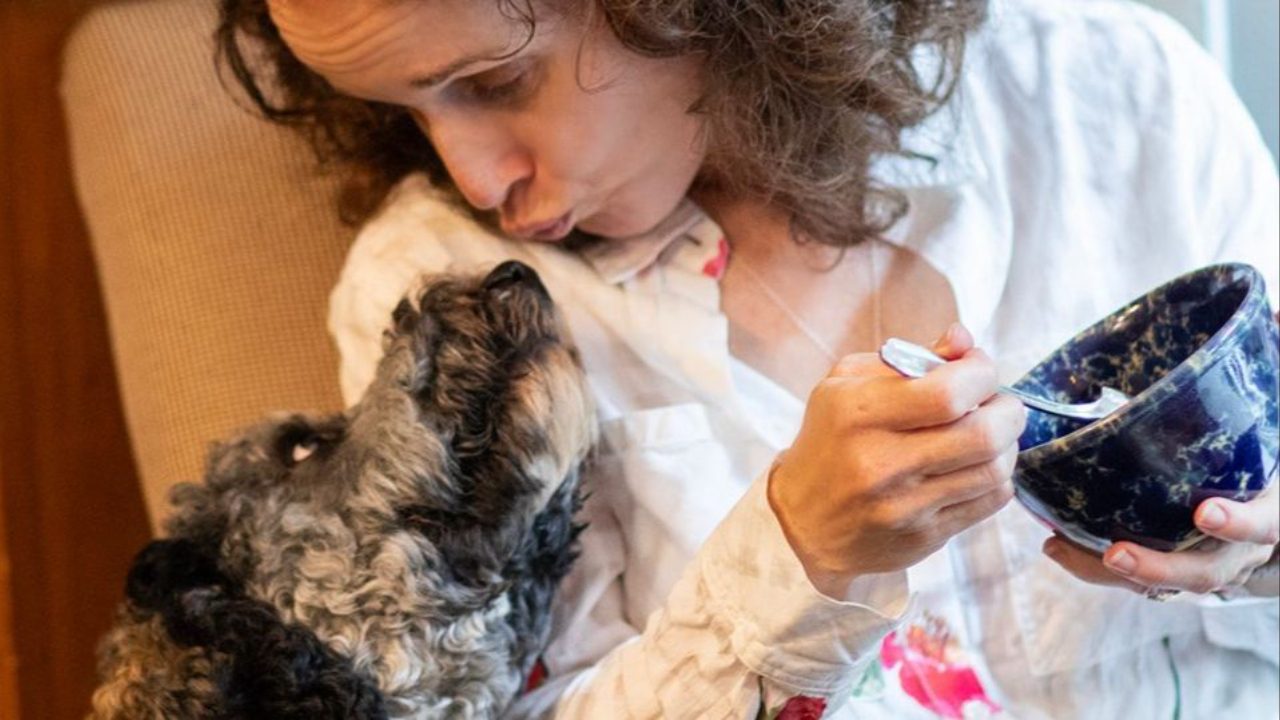
The mom told me about her evenings, after her young child goes to bed. The house gets quiet. And then her anxiety gets really loud. She turns on the TV, often a food show, and she eats. She's not hungry. She simply notices that the food feels so much better than her anxiety. Sometimes she pours a glass of wine. Sometimes she scrolls her phone until her eyes burn. She told me, in her own words, that it feels "like drugs. Everything is finally okay when I scroll. I don't want to stop."
Eating, drinking and scrolling: three different behaviors and yet each one is a way of getting the nervous system to settle for a minute when nothing else will. They are reproducible patterns of coping. They show up because they reliably do something for her.
The real question, the one the meal plan cannot ask, is this. What is she coping with?
Listen, she already has a great therapist. She is on a medication that helps her. Those supports are doing real work for her during the day. But anxiety has its own clock, and hers does not stop when the day ends. The ongoing hum that runs underneath everything gets quieter in the morning and louder at night. By the time her child is asleep and the house is still, there is nothing left between her and the volume. That is when the food, the wine, and the scrolling step in. These are not random behaviors. They are practiced. They have been the reliable thing for so long that her body reaches for them before her mind catches up.
That changes where the work is. It is not in another medication. It is not in another meal plan. It is in understanding the shape of her own anxiety, what it does, when it gets loud, and how three specific habits have been trained to answer it.
Why Family in Focus is not therapy, and not a diet
I work with parents, and one of the first things I tell people is that I am not their therapist. I have one. I think therapy is a beautiful tool. What I do is different.
I am also not a meal planner. (My family will readily admit that you do not want meal tips from me.) I do not count portions. I do not hand anyone a list of forbidden foods. I do not weigh anyone, and I do not ask them to weigh themselves for me. I am willing to say that while "eat less and move more" may be true, it is not useful, because it does not touch why we eat, and why we don't move more.
So if it is not therapy and it is not a diet, what is Family in Focus?
It is the work of looking at the whole person and the whole context she lives inside. It is family pattern and relationship coaching. And it always starts with supporting parents. We start with what is already working, because every parent walking into this work is already doing more than they get credit for. We notice the patterns of food, of body, of sleep, of stress. We notice the voices that show up in our heads when our kid asks for a second cookie, or when a child melts down because someone made a comment about their body. A lot of those voices, it turns out, are not ours. They are inherited. We learn to recognize whose voice is whose, and we get to decide which ones we want to keep speaking out loud in our own homes.
We build new patterns through carefully conducted small experiments, the kind that are so simple they are practically done already. Instead of wholesale interventions that only last a short period of time because of all of the pushback and resistance faced, we develop a plan for sustainable new habits.
And underneath all of it, a different relationship with the body. Body size is a form of human difference. The bodies in your house, including yours, get to be cared for, not fixed, not shamed, not reduced to a number.
What becomes possible
Parents who do this work tell me a few things, again and again.
They tell me that the food gets quieter. Not because they finally cracked the code on portions, but because the problem the food was trying to solve got smaller.
They tell me their kids change too. Not because we ran an intervention on the kid. Because the parent changed, and the kid is the most attentive student of the parent's nervous system in the house. When a parent stops being anxious around food, the kid is able to relax themselves. When a parent stops weighing the family's worth by the scale, the kid steps into their own self-worth.
More and more parents are stepping back from the weight conversations they were handed growing up, and finding a different way to be in their families. A generation of parents is changing this conversation together. There is room for you in that.
"I want to fix this before it's too late for my kid."
This is the sentence I hear most often when parents first reach out. They have been told, sometimes by a doctor, sometimes by their own worried mother, sometimes by a number on a growth chart, that the window is closing. That they have to act, now, on their kid's body.
Most of the parents who say this to me are themselves struggling with their own bodies, their own patterns, their own inherited voices. They are not asking me to fix the kid because the kid is broken. They are asking me to help them, before they pass on what was passed to them.
Here is what I want you to hear. It is not too late. And the place to start is you. Not because you are the problem. You are not. The place to start is you because you are the one who can actually do this work, in your own life, in your own kitchen, in your own self-talk. When you start there, everything downstream of you, including your kid, gets the benefit.
Let's talk about what is possible for you and your family.
Dr. Wendy Schofer, MD is a dual-board certified pediatrician and lifestyle physician of 22+ years, improv comedian, and trauma-informed parenting coach. As Founder of Family in Focus®, she is on a mission to help 1 million families strengthen relationships with food, body, and especially each other. This is how we create change without harm and actively prevent eating disorders.
Check out the Family in Focus with Wendy Schofer, MD Podcast!
Stay connected with news and updates!
Join our mailing list to receive the latest news and updates from our team.
Don't worry, your information will not be shared.
We hate SPAM. We will never sell your information, for any reason.